
Frenchtown City Directory Holdings
Frenchtown Township sits in Monroe County, so the historical shelf is a Monroe city and county directory search rather than a promise that every volume covers the township. The Monroe County Library System genealogy collection at the Ellis Library and Reference Center brings together city directories, land and plat maps, census transcriptions, probate material, church records, oral histories, and microfilm. The Library of Michigan guide describes the publisher types and access routes, but it does not publish an exact Ellis shelf inventory for every Monroe or Frenchtown year. Check the catalog or ask staff before treating a listed lead as a local volume.
| Directory collection | Documented period | Where to start | How to reach it |
|---|---|---|---|
| Polk-style city directories | Late 1800s generally; Monroe leads include 1916 and selected 1946-1959 years | Ellis catalog, Library of Michigan, and listed library collections | Print, microfilm, library databases, then catalog verification |
| Bresser criss-cross directories | Late 1960s generally; exact Monroe run not published | Library of Michigan and local/county catalog | Address-first lookup; confirm volume and coverage in person |
| Lake Shore Gazetteer and Business Directory | 1861-1862 Monroe/Newport lead | Cross-library catalog record | Catalog or reading-room request before relying on coverage |
| Monroe newspaper microfilm | News-Courier 1915-1919; Evening News and Monroe News 1918-2019 | Library of Michigan and local library or museum routes | Microfilm, reading room, or custodian inquiry |
Publication gaps matter. A missing year can reflect a coverage decision, an unlisted household, a catalog gap, or a volume that is only available at another institution. Record both the year searched and the custodian. That note is more useful than assuming a blank result proves a move.
Monroe's Frenchtown Directory Gateway
Monroe city and county volumes are the practical historical gateway for Frenchtown research. Polk sometimes includes suburban coverage, while Bresser volumes are often county directories, but neither fact makes a given book a complete Frenchtown Township census. Start by checking its title page, geographic scope, and street coverage. A Monroe mailing address can also point to Frenchtown Township, the City of Monroe, or another nearby jurisdiction. Northern township addresses can use the Newport postal route. Those geography details help explain why a surname or street does not appear where expected.
The first useful local leads are the 1861-1862 Monroe/Newport gazetteer and selected Monroe directory years from 1916 and 1946 through 1959. They are research leads, not a verified run at one counter. The Library of Michigan's Monroe County guide also identifies historic books, newspapers, plats, and first-landowner atlases. Use a plat or legal description when an old road name, a private claim, or a postal label prevents a clean address match.
Note: A directory should be cited as a dated publication, with its publisher, volume year, page or street section, and the place that supplied it.
Frenchtown City Directory Reading Routes
The Library of Michigan city-directory guide separates the familiar formats. A Polk volume can be read through a surname section, a street section, a phone-number section, or a classified buyer's guide. That gives a researcher several ways to find the same printed name. A Bresser volume is the reverse route: streets are alphabetical, house numbers run in order, and the head of household is tied to a phone number, ownership notation, first-listing information, a new-arrival note, or a move within the covered area.
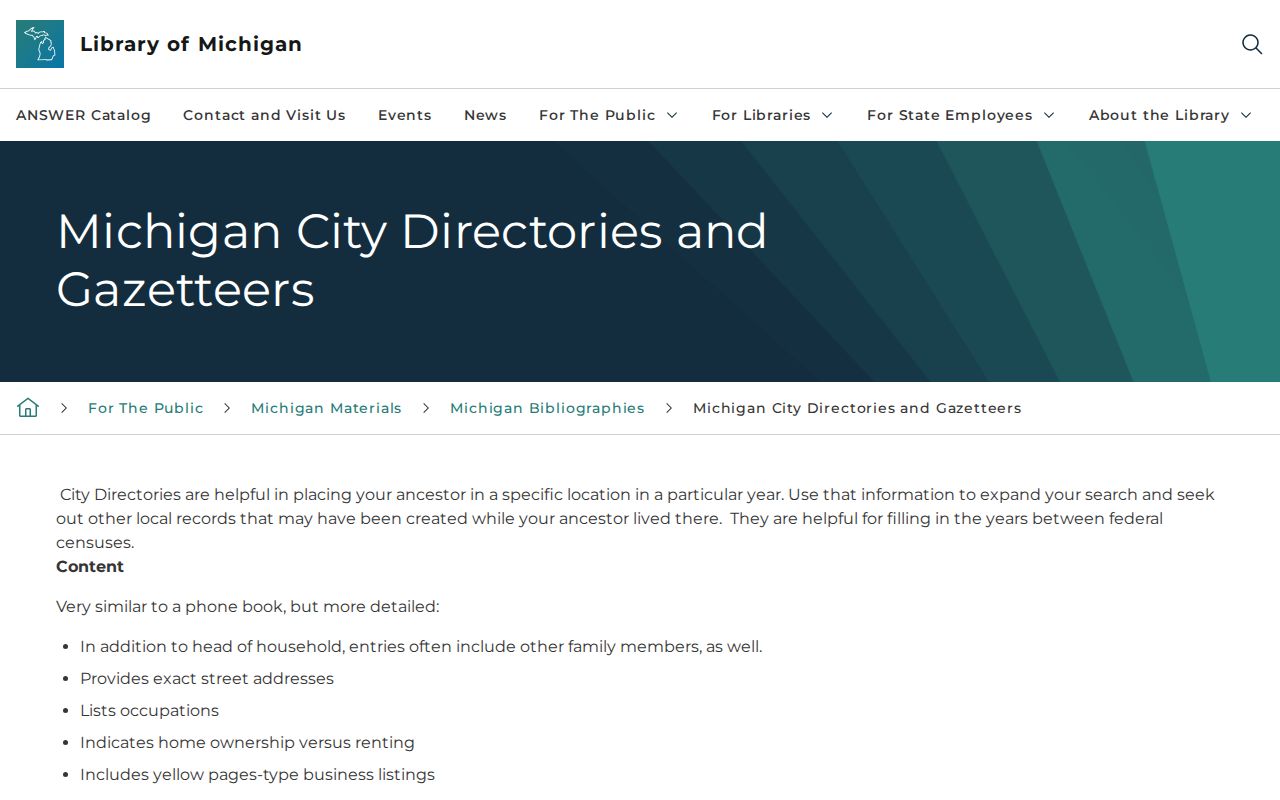
The image below comes from the Library of Michigan's city-directory guide, the source that explains Polk and Bresser layouts.
Use the guide to choose the right section first. A name search answers a different question from an address-first criss-cross search, and neither format confirms continuous residence by itself.
Reading a Frenchtown City Directory Entry
A directory entry should be transcribed before it is interpreted. Polk surname entries can show the printed name, a spouse or other household member, occupation, and sometimes an employer or business affiliation. Street entries can add the house number and place people and businesses in numeric order. Phone pages usually focus on a head of household. Bresser's reverse format can add a first-listed, new-arrival, relocation, or ownership notation. Those fields are clues. They do not establish who was present every day or who was omitted from a publisher's list.
| Printed name | Copy initials, spelling, and married-name form exactly. Search variants in the next volume. |
|---|---|
| Household detail | A Polk surname entry may name a spouse or another household member; the street view may instead name only a head of household. |
| Work or business line | Occupation, employer, classification, advertisement, or building placement can separate similar names. |
| Street and number | Keep the address as printed, then compare it with a plat, legal description, or current parcel only after noting the directory year. |
| Status notation | Record any ownership, first-listing, new-arrival, or move notation without expanding an abbreviation that the volume itself does not define. |
- Criss-cross directory
- An address-first directory: streets and house numbers lead to a head of household, often with phone and move-related notes.
- Householder index
- A listing organized around the named household contact rather than every person connected to an address.
- Abbreviation key
- The publisher's explanation of short forms. The actual Monroe key was not located, so inspect the front matter of the specific volume before expanding a mark.
Ellis Library's Frenchtown Directory Layers
The Ellis Library and Reference Center holds the Monroe County Library System genealogy collection on its second floor. It combines print, electronic resources, and microfilm, and its Reference Center follows Ellis Library hours while closing fifteen minutes earlier. Questions can go to Ellis or Ask a Librarian. Blue Bush and Frenchtown Dixie are useful local branches for access and routing, but the genealogy shelf itself is centralized at Ellis. MCLS lists Ancestry Plus, FamilySearch, LaFrance, and Seeking Michigan or Michiganology among its research databases; passwords may be available through any branch.
When a desired volume is not online, use the published layers in order: ask Ellis staff for the city or county catalog record, check print or microfilm, ask whether a library database has the volume, then consult the Library of Michigan. Its guide identifies print directories on 2nd Floor South, microfilm and fiche in the Microfilm Room, and online routes through Ancestry Library Edition or HeritageQuest. This is a better fallback than substituting a commercial compilation for the volume itself.
Frenchtown City Directories Between Censuses
Use the available city directory years to build a cautious household timeline between federal census releases. The goal is not to force every gap into a single explanation. A name can vanish because of a move, death, marriage or other name change, nonlisting, a changed directory boundary, seasonal absence, or a missing volume. Pair the directory with a census, a deed or tax record, and a dated newspaper item before treating a transition as settled. The collections themselves support historical work; modern address records belong on the Frenchtown Township street directory page.
- Find the surname with likely spelling variants and copy the address, household wording, work line, and any printed status notation.
- Check the preceding and following available directory volumes, not only consecutive calendar years, and retain the gaps in the timeline.
- Open the street or criss-cross section for the address to identify the listed household contact around the same number.
- Pair the closest volume with the applicable federal census release, using census composition and age clues to test the directory match.
- Close a major change with a recorded deed, obituary, probate file, cemetery record, church record, or permit where available.
A federal census covers household composition, ages, birthplaces, and occupations. A directory is often better for the in-between address and printed work clue. Preserve both kinds of evidence separately rather than treating either as a complete list of everyone at a property.
Frenchtown Directory Clues in Newspapers
Newspapers can test a city directory finding when the spelling, address, or household change needs context. The Library of Michigan's Monroe guide lists the Monroe News-Courier from 1915 through 1919 and The Monroe Evening News and The Monroe News from 1918 through 2019 on microfilm. Search a surname with a street, beach subdivision, or postal place name such as Stony Point, Woodland Beach, Detroit Beach, Erie Shores, or Newport. An obituary may use a later married name, while a real-estate notice or civic item can anchor a date between directories.
Do not turn a newspaper mention into an address history on its own. Compare the date and name form with the volume, county deed material, probate, cemetery files, or the library's local-history collection.
Frenchtown Directory Gaps and Fire Losses
Monroe County's record history makes a careful negative result essential. The 1839 courthouse was badly damaged by fire on February 28, 1879, and a 1992 arson fire also damaged county offices. County history says some partially burned records remain, but an absent index entry can reflect destruction, nonfiling, an indexing gap, or another custodian. In December 2025 and January 2026, county officials sought up to $750,000 for preservation of historic vital, land, and military volumes, including material without a digital or microfilm duplicate.
The Monroe County Museum System is another local-history route, although its Archives is closed for construction in 2026 and obituary research is unavailable during that closure. Confirm access before visiting. The Archives of Michigan, Ellis, county offices, newspapers, and a targeted Michigan FOIA request are distinct fallback channels when a directory lead ends.
Note: A useful search log names the volume or index, year range, spelling used, page or street section, access date, and the next custodian to contact.