
Frenchtown Township Resident Lookup Records
No official source is a complete roll of Frenchtown Township households. The useful record depends on the question. A tax record can connect an owner with a parcel, while a voter record can show a registration status and a court register can identify a public case. Use two independent anchors before treating a result as the same person.
| Record | What It Confirms | Where to Search | Access |
|---|---|---|---|
| Assessment and tax roll | Tax-roll owner, parcel, situs and mailing clues | Frenchtown BS&A Online | Public reference search |
| Registration record | Registration status and, by proper request, public QVF fields | Michigan Voter Information Center | Personal lookup or QVF request |
| Court register | Public case number, parties, dates and disposition | MiCOURT Case Search | Online register; clerk for files |
| Vital and probate records | Events, estate parties and family trail | MDHHS and Monroe offices | Rules vary by record |
| State filings | Public business or license affiliation | LARA records | Search or certificate route |
Use a parcel or a recorded deed when the question is ownership. Use a public registration route only within its limits, and use a court case number rather than a name alone whenever possible. Renters, children, protected people, and people who own no property may not appear in the tax roll. A missing result is not proof that a person never lived in Frenchtown Township.
Checking Names in Frenchtown Township Courts
MiCOURT Case Search is a public register for the 1st District and 38th Circuit courts serving Monroe County. The official terms identify court, case category, party name, case number, and date, status, or result browsing as search dimensions that depend on the court selected. It is a lead, not the official file.
A public result can show party role, case number, case type, charge or claim, filing and hearing dates, and a disposition. It may not provide images or pleadings. Adoption, juvenile, mental-health, name-change, personal-protection, and other excluded categories are not ordinary public results. Some courts apply a seven-year criminal-sentence display limit. For a needed record, give the clerk the court, party name, year, case number, and whether a plain or certified copy is wanted.
See the MiCOURT search screen before starting a name query.
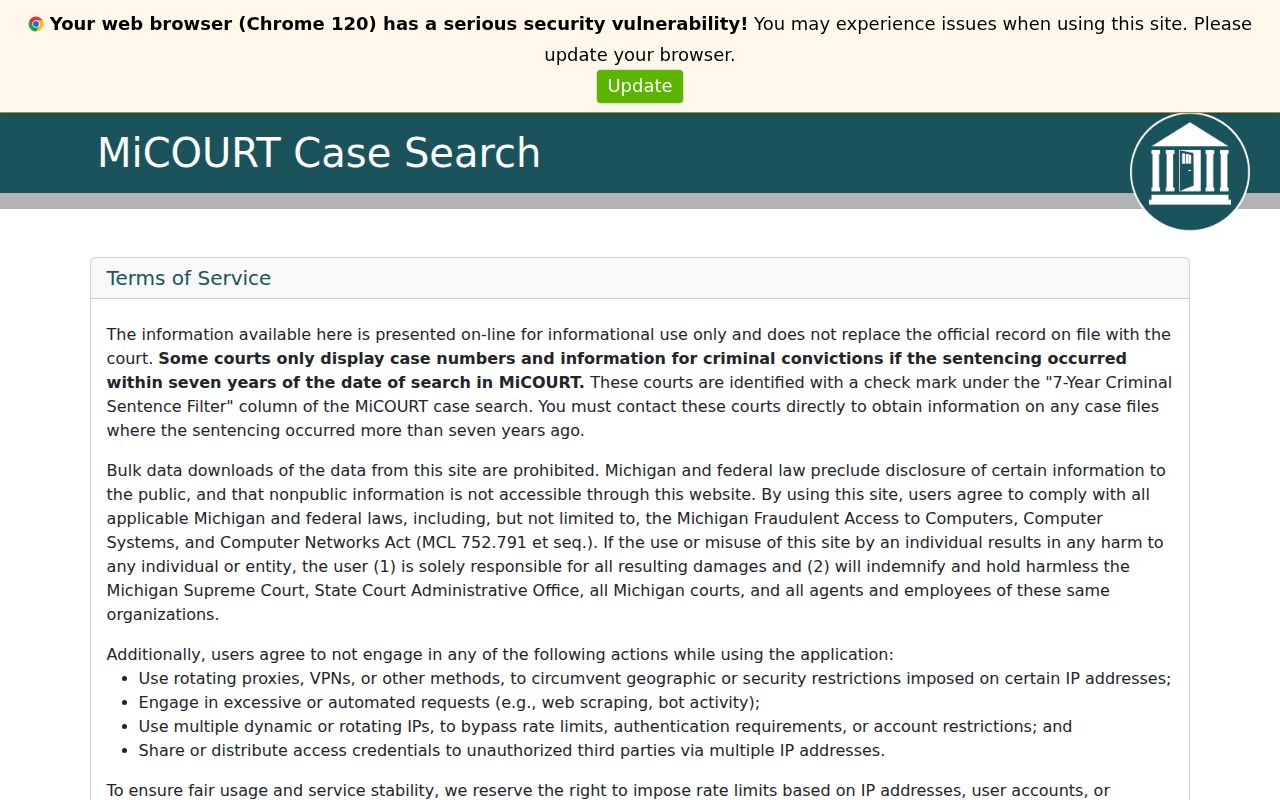
The terms-and-continue screen is a reminder to match a court result with independent address, family, or document evidence.
Matching a Frenchtown Township Name
Common names need a second anchor. Preserve the spelling returned by each custodian, including initials, maiden or married names, suffixes, trusts, estates, and business styles. A property result may use an owner or trustee, not an occupant. A business or professional filing may use a service address, not a home address.
- Search the name in BS&A and record the parcel, situs address, mailing address, legal description, and approximate sale date.
- Compare the name with an authorized personal registration check or a jurisdiction-specific QVF request. Keep protected fields out of notes.
- Use the tax-roll name and sale year in the Monroe Register of Deeds grantor and grantee index. The deed office does not search ownership by street address.
- Check MiCOURT or Probate Court with the name variation, then ask the clerk for the public file route if the register identifies a case.
- Confirm an important family event through the proper MDHHS or Monroe County certificate process.
Note: A same-name match should be held open until at least two independent record paths agree on the person and time period.
Verifying a Frenchtown Township Resident
Michigan’s voter system separates a personal status lookup from a request for a public Qualified Voter File slice. A QVF request can be scoped to a county, township, precinct, school district, or other defined geography. Public fields can include name, residential and mailing address, year of birth, registration date, status, voter ID, and requested voting history, while protected fields are removed under MCL 168.509gg.
- Docket
- A court’s running list of filings, hearings, and actions in one case.
- Index and image
- An index helps locate a record; the underlying document image may be unavailable online or require a custodian request.
- Certified copy
- A copy issued by the custodian with certification, used when an official document rather than a search lead is needed.
Michigan birth records have additional limits. Records under 100 years generally require the subject, an eligible representative, an heir, or a court route. Death, marriage, and divorce certificates are generally available with the fee, while confidential probate marriages remain limited. The Monroe Clerk provides a county genealogy route for older material and keeps its indexes in a secure research area.
Frenchtown Township Probate and Vital Trails
For a deceased resident, Monroe County Probate Court public access can identify an estate, fiduciary, petitioner, and dates. A probate file can then connect an estate name to a death certificate, obituary, recorded conveyance, or heirs. Sensitive attachments and wills may need a direct file request, so do not assume the web docket contains the full record.
Michigan MDHHS accepts vital-record orders online through its named provider, by mail, sealed drop box, appointment-only in-person service, and selected will-call pickup. The Monroe Clerk is a local channel for county-held copies and historical genealogy requests. A certificate establishes a state or local record; a newspaper index or an obituary is a useful lead but does not replace it.
The county’s historical record has gaps. Marriage material begins locally in 1818, death material in 1867, and birth material in 1874. A courthouse fire in 1879 and later courthouse damage in 1992 make a missing hit less conclusive. Ellis Library, county offices, the Archives of Michigan, and newspaper microfilm supply separate fallback paths.
State Results That Need Context
MiBusiness Registry and LARA’s MiPLUS license search can confirm a public filing, professional credential, status, or date. They are useful when an identity has a public business or license connection. A registered agent, licensee, permit applicant, or corporate officer can use an office address, so that result is an affiliation clue rather than proof of a private residence.
Michigan’s offender registry has a separate, limited public purpose. Its official page permits name, address, ZIP, and radius searching for published registrants and updates, but it is not a general resident roll or a complete criminal-history search. Use it only for lawful public-safety awareness and rely on the designated state and court channels for record questions.
Open the Michigan State Police registry page for its current search modes and notification instructions.
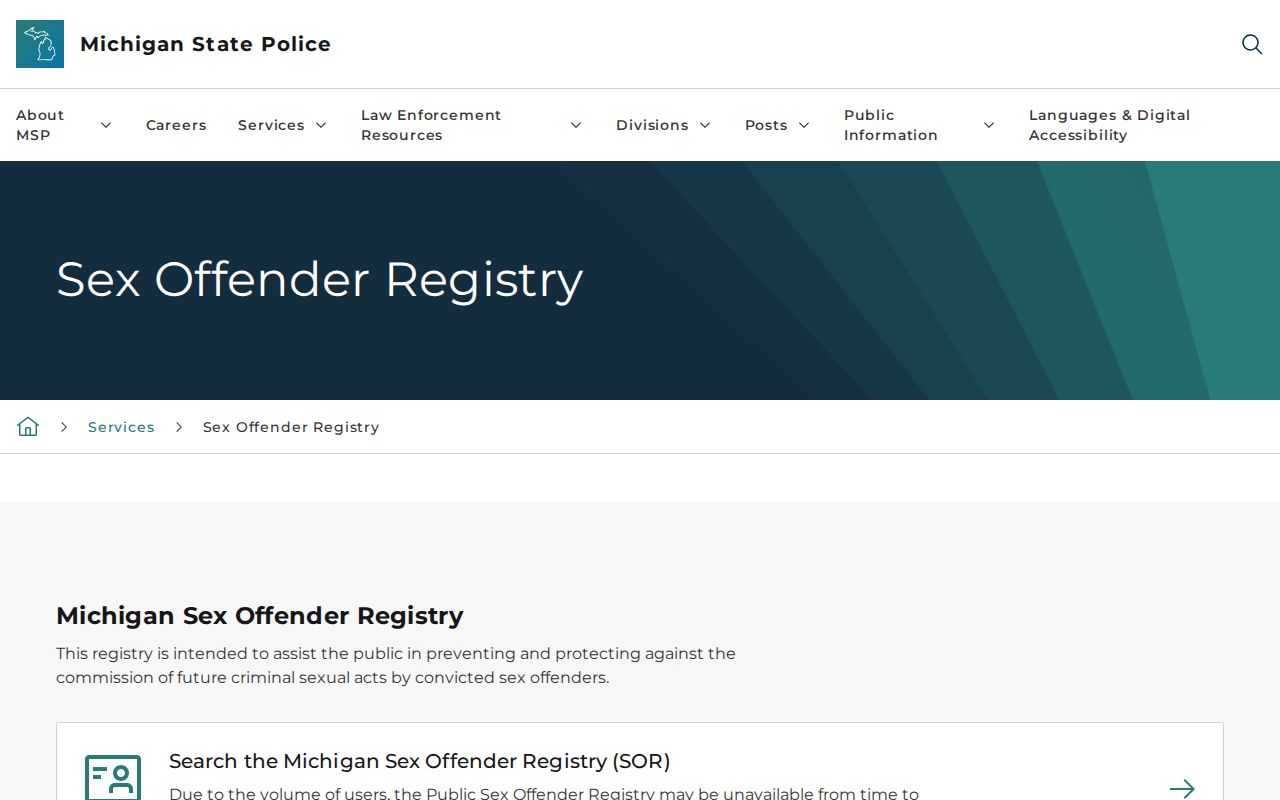
The official registry describes its own scope, which is narrower than a resident lookup and changes as records are updated.
Frenchtown Township Lookup Request Routes
When no web index answers the question, ask the correct custodian for a narrow record. The Michigan Freedom of Information Act, 1976 PA 442, MCL 15.231 et seq., applies to public bodies and requires a request that describes the record. Monroe County’s FOIA form is a county route. Courts follow court-record rules rather than the ordinary FOIA route when acting as court clerks.
Give the office a name, address or parcel if known, date range, record type, and requested field or copy. The Attorney General notes that search terms and date ranges can reduce cost. For older local records, Ellis Library’s second-floor genealogy collection holds directories, land and plat maps, cemetery work, probate, oral histories, church records, and microfilm. The county museum’s archive service is currently affected by construction, so confirm availability first.
Frenchtown Township Identity Details
Small differences in a result often solve a same-name problem. Compare the parcel’s legal description, a deed recording date, a probate estate number, a court case number, or the year of birth allowed in a public voter-file product. Preserve a surname exactly as the record prints it. Early French-family spelling, initials, later married names, and a Monroe or Newport postal label can each make an exact-match search fail.
A business filing or professional license can add a useful time-stamped affiliation, but it should not be converted into a home-address claim. The same rule applies to a recorded deed: it establishes a recorded ownership interest, not who was physically present at a property. When sources disagree, return to the custodian rather than trying to reconcile the facts with a generic people search.
Limits on Frenchtown Township Resident Lookup
Michigan protects addresses for Address Confidentiality Program participants and removes identifiers, contact details, signatures, and other fields from public voter data. DMV information is not a general public address source. Court rules also restrict sealed, juvenile, adoption, mental-health, and expunged matters. A person absent from a public list may be a renter, a child, unregistered, protected, or simply outside that source’s time range.
Lawful use. Use Frenchtown Township resident lookup records for personal, lawful research and verification. Michigan stalking law, MCL 750.411h, prohibits repeated harassment and unwanted contact; public records never authorize intimidation or harm.
Correct a record with its custodian: the assessor for a tax entry, the Clerk or elections office for registration, a court clerk for a register, MDHHS for a vital certificate, or LARA for state filings. Note: Keep an access date, exact spelling, jurisdiction, and case or document number with every research result.